
Where Are You?
Here I Am

Walking my dog Capa each morning along the pathway below the Eastern Promenade here in Portland, I am always struck by certain encounters with fellow walkers of dogs, each of whom have their own quirks and peculiarities related to perambulating with their pets. From leash policy to jumping on and sniffing out others to variously held expectations for canine mores, there’s always something to notice in each interaction – between and among us humans and dogs.
Alas, in our digitally saturated age, I’ve recently been struck by the distinct lack of the dialogic, of questions, that remain unexpressed in these moments tragically bereft of inquiry. After the usual inquiries – what’s your dog’s name? How old? What’s that breed? – curiosity might just as well be scooped, bagged and thrown away, along with other unwanted material on the trail. Who we are, what we do, how we ourselves are coping with life on this planet – while are dogs are more or less blithely making their way through it all – are generally ignored as topics, made all the more elusive by headphones and screens, the algorithmically crafted barriers to the existentially dialogic reality of existence.
I always try to ask, nevertheless; my own Sisyphean trek up and down the mountain of the I-Thou encounter. Curiosity may have killed the cat but it hasn’t reached me yet. There’s just stuff I want to know.
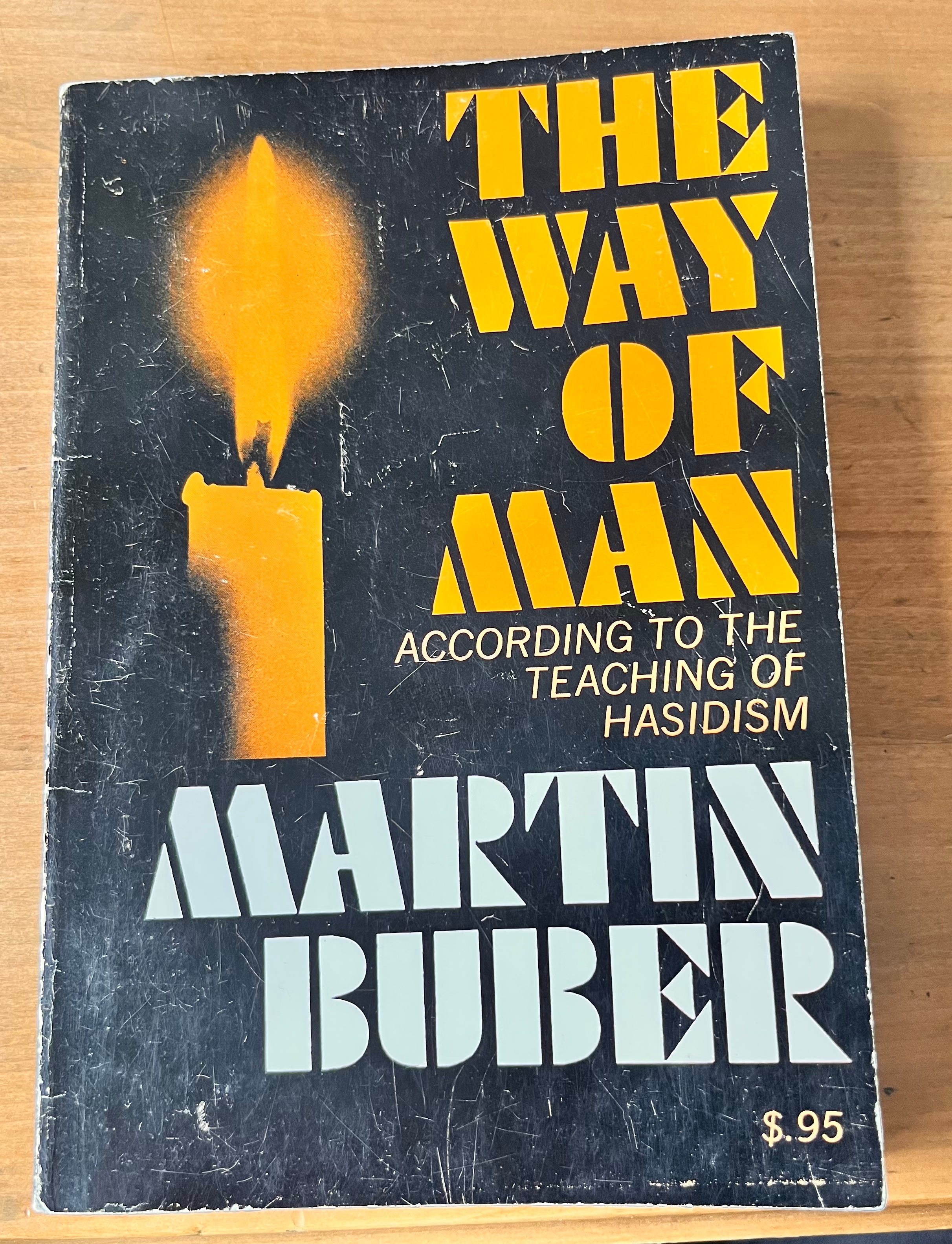
I’m reminded of an essay Martin Buber wrote in a small collection of Hasidic teachings called The Way of Man. Reflecting on the question that God asks Adam when he hides in the Garden of Eden after eating the forbidden fruit from the Tree of Knowledge of Good and Evil, God asks Adam, “Where are you?” First of all, Buber writes, “God does not expect to learn something he does not know; what he wants is to produce an effect in man which can only be produced by just such a question, provided that it reaches man’s heart – that man allows it to reach his heart.”
Buber goes further, refusing to let us off the hook in our hiding. “Adam hides himself to avoid rendering accounts, to escape responsibility for his way of living. Every man hides for this purpose, for every man is Adam and finds himself in Adam’s situation. To escape responsibility for his life, he turns existence into a system of hideouts.”
We hide not only from God but from each other. And in the end, as Buber points out, we hide from ourselves, down, down, down into our screens: digitized, quantified, monetized. “Man cannot escape the eye of God, but in trying to hide from him, he is hiding from himself…This question is designed to awaken man and destroy his system of hideouts; it is to show man to what pass he has come and to awake in him the great will to get out of it.”
We are a paradoxical age, awash in a roiling sea of institutional and collective instability, perhaps best characterized as a crowded and chaotic oceanscape of infinite ships of certitude, banging and clanging against each other. We are buoyed by a false sense of the realities we can conjure exclusively for ourselves by tapping a screen, descending into our truths, and shutting out all around us with curated playlists, podcasts, and social platforms. Bob as we may, catching what breath we can, we are drowning. Our redemption, perhaps, is for those who recognize that in having been swallowed by the Great Fish that took in Jonah, who ran from himself as well, we in fact are being saved.
Rabbi Tarfon taught, according to the ancient midrash, that since the creation of the universe, the fish had been appointed to swallow Jonah. Our creations consume us and in the end, our realization that we have been swallowed alive, might save us as well.
From the belly of the whale, Jonah cried to God: “You cast me into the depths, into the heart of the sea; the floods engulfed me, all your breakers and billows swept over me…when my life was ebbing away, I called God to mind; and my prayer came before You into Your holy temple. Those who cling to empty folly, forsake their own welfare. But I with loud thanksgiving will sacrifice to you; what I vowed I will perform, deliverance is God’s.” And then the text concludes, “God commanded the fish and it vomited Jonah out upon the dry land.”
Rabbi Hank Skirball, of blessed memory, gave me a copy of The Way of Man at the end of a year of study I completed with him in 1985-86 in Jerusalem. For 9 months of Sundays from September to May, Hank agreed to a one on one tutorial in his office in the Rehavia neighborhood, just outside the clamor of Jerusalem’s city center. I’d schlep into town from Mount Scopus and exchange the two or three books he had given me the prior week for a new set of texts, more questions, a sharper mind and hopefully, a more open and modest soul. Certainty withers in the face of the scrutiny of the I-Thou encounter. “I don’t know” is the key that unlocks the door to the palace. “Where are you?” is the whale that swallows you whole with the question, and then expels you, onto the dry land, your survival a response to the question, your life a dialogic expression, girded by faith, grace and mercy.
After our last study session, Hank retrieved this small volume from a corner of his desk, placed his hands on my shoulders, and said, “Go be a rabbi.”
Here I am.
Thank you, Andy. What a beautiful post.
How beautiful that Rabbi Skirball found you out of your whale on the beach of your journey and fed you the right books and ideas, and care.