
We Can Always Do Better
The Fire That Sustains

It’s important to remember, as world war overwhelms and as President Trump has yet to fully articulate strategic goals for the war, that a different kind of war continues at home. If you live in a state where there is ongoing I.C.E. activity and you are regularly in the habit of seeing these ominous enforcers of the Trump border policy — a policy mired in dysfunction and corruption, as evidenced by Secretary Kristi Noem’s ignominious term of service that came to an appropriately abrupt end recently — you know what I am talking about.
It’s not quite a citizenry divided by Union Blue and Confederate Grey but there are markers, signifiers. My car, for instance, has a Ukrainian flag on the back but not an American flag, which has earned the opprobrium of more than a few enraged truck drivers over the last couple years and in more than one instance has led to me being tailed, screamed at and nearly driven off the road. It’s clear from their response that I’m not following orders for an unspoken, patriotic uniformity of purpose. I knew the purpose of this neanderthalish behavior was to intimidate me. But I was raised by a father who never backed down from a fight and an uncle who was known to let a raging antisemite have it with his closed fist, trained as he was in the sweet science of boxing as a Big Ten fighter at UW-Madison in the Fifties. Put plainly, I’m not going to stop being my kind of American — an American who believes in the Constitution, a representative democracy, the right to vote for all citizens, and an immigration policy that remains rooted in the Biblical commandments to welcome the stranger and to love thy neighbor as thyself.
But apparently that’s a heavy lift these days. Frankly, I’m glad my parents aren’t alive to see this. My dad would have had three heart attacks all at once (and all it took was one to kill him) and my mother would just shake her head in disgust and knit fourteen blankets, weave twelve baskets, and make a cross stitch of the Bill of Rights.
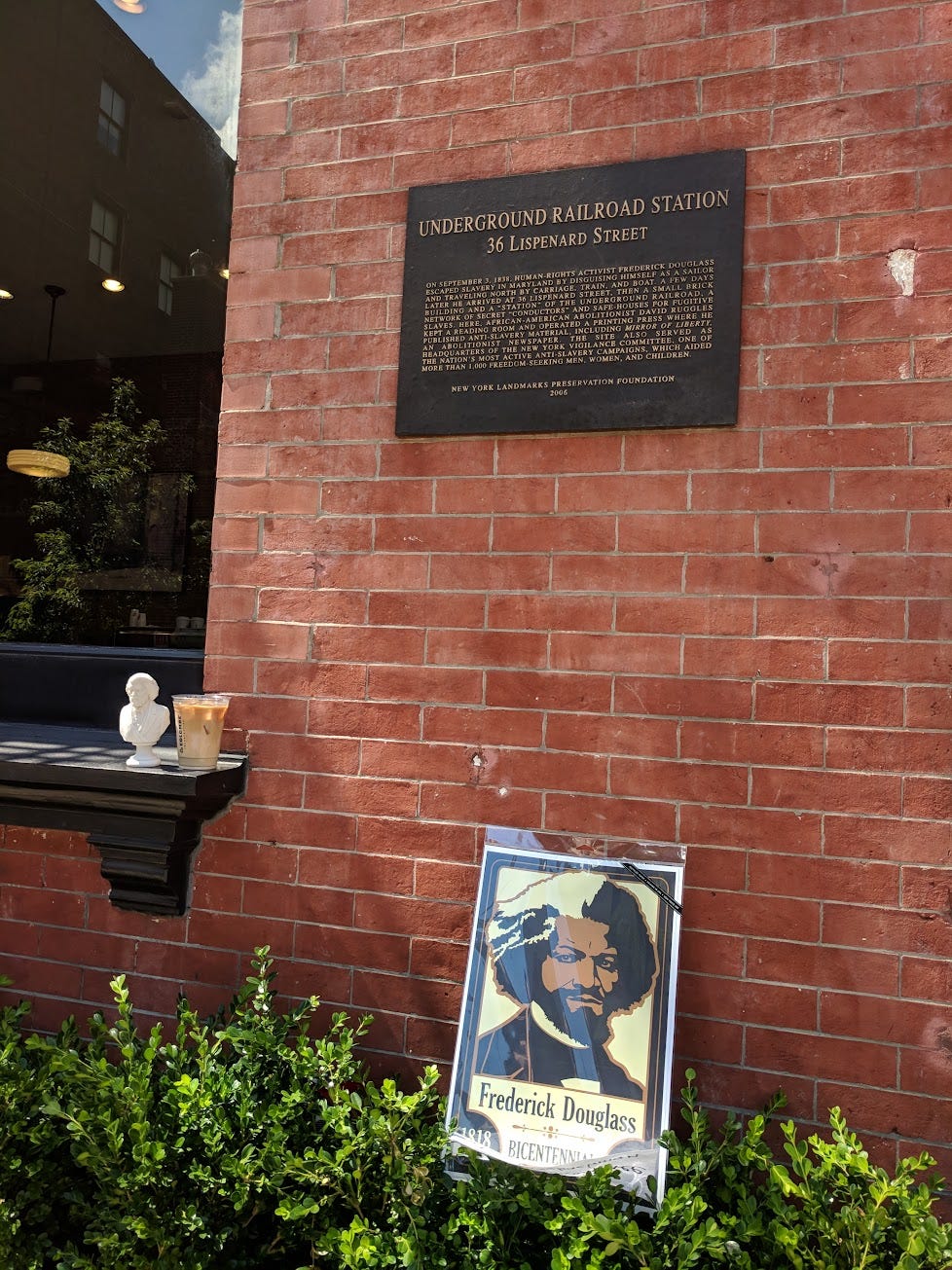
Anyway, my parents were newspaper readers — big time. In the Milwaukee of my youth, the Milwaukee Sentinel was delivered each morning and then the Milwaukee Journal arrived in the late afternoon. This was not uncommon during the golden age of American journalism, a tradition deeply rooted in the foundational ethics of the American project itself. As Jill Lepore, among others, has pointed out in her magisterial works on the United States, leaflets and newspapers were essential to the way that information spread among the colonies — from opinions and diatribes to the dissemination of the founding documents themselves. The citizenry was literate and well-informed. And as Abolitionists surely knew, one of the most essential tools in the battle against slavery was teaching Black Americans how to read. It’s not by chance, for instance, that when Frederick Douglass, who famously tricked white boys in Maryland to teach him to decipher the alphabet and was then taught to read by a subversive white woman, escaped to New York City to the home of David Ruggles, a Black Abolitionist and newspaper publisher whose paper, Mirror of Liberty, was printed and disseminated from his home at Church and Lispenard in Lower Manhattan where Douglass was harbored, married to his wife Anna, and then given passage to northern New York by the Underground Railroad. (Now a La Colombe coffee shop.)

Here in Maine, many of the local papers are owned by the Maine Trust for Local News. Rather than succumb to the anodyne, uniform, blandness of say, the USA Today Company (formerly Gannett) which owns more than 200 local papers across the country — including the Milwaukee Journal Sentinel, a shadow of its former selves — the Maine Trust is local, independent, community supported news reporting that still thrives here in Maine.
I’m not alone in appreciating the community roots-based patriotism of this shared philanthropic, non-corporate effort.
In the lore of popular American politics, it was Tip O’Neill, Speaker of the U.S. House of Representatives and Irish American Bostonian (Happy St. Patricks Day!) who is credited with the phrase “all politics is local” (though, like many turns of phrase, it has a variety of origins.) In my last years living in New York, I was among many who deeply mourned the gutting of local news coverage by the New York Times, the Wall Street Journal, and the traditional dailies, in favor of a more national, digitally oriented, profit-driven journalism product. As a small badge of pride for my more than 33 years as a New Yorker, I enjoying seeing the monthly deduction from my bank account for my subscriptions to The City and the Gothamist, two institutions that have stepped into the breach made by the corporate power-washing of our unfortunate generation. I don’t always agree with their editorial approach but at least it’s a debate happening among us all in a printed town square, not a distant board room driven by profit and the bottom line.
Here is my point. In the March 7 edition of the Portland Press Herald, there was an article written by the staff writer Rachel Estabrook entitled, “At Least 5 from Maine are in an Arizona ICE facility where a man died this week.” It opened with the line,
”At least five people detained in Maine by immigration agents during a January surge are being held at an Arizona facility where a Haitian man died this week of sepsis caused by an untreated tooth infection, according to his family.”
A Haitian immigrant to Maine died in a facility in Arizona because a tooth infection wasn’t treated.
Sit with that.
I have been haunted by it — appropriately, as you should too, frankly — all week.
The reporter Rachel Estabrook writes that “concerns about the conditions at the Central Arizona Florence Correctional Center and other ICE facilities underscore that immigrants without criminal records, including some of those who were targeted in Maine, are spending more than a month in custody, often in prisons that were built for people convicted of crimes.”
She continues, “Marcos Gaspar-Da Silva, who has no criminal history and is in the process of applying for a green card, is one of the Maine detainees at the central Arizona facility. He’s been there for a month. His wife, Alessia, is a U.S. citizen and said while Marcos is in a special part of the prison with more freedom than the general population, he’s sick from drinking the water and eating food that’s cooked in it. He’s having gastrointestinal problems and vomiting that seem to get better only when he avoids the water, she said.”
Are you reading this?
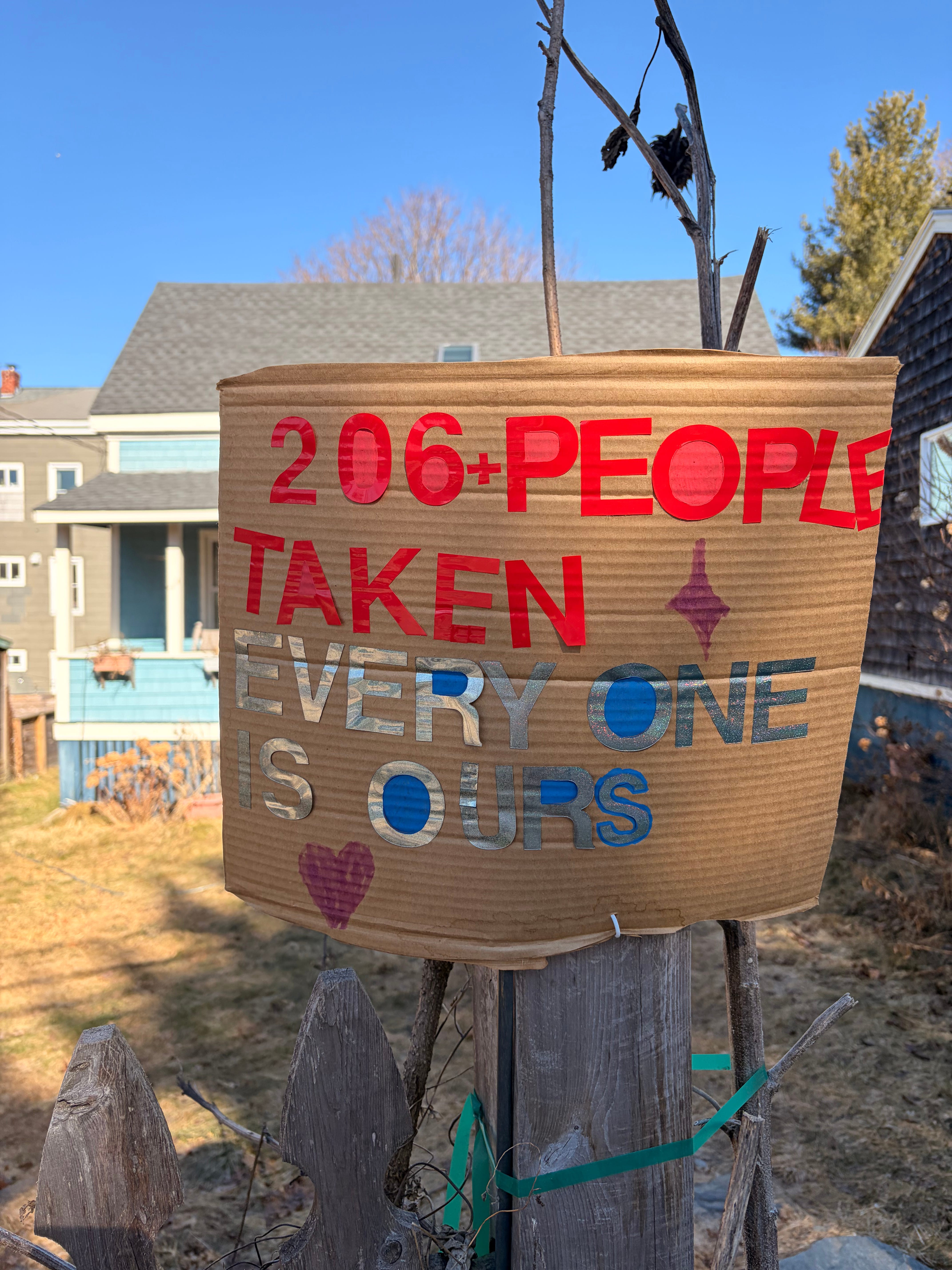
It’s the haunt that hurts the most. It’s the proximity to reality that anyone who cherishes — not a word to be taken lightly at all: cherish, love, revere, a neighbor as oneself, for instance — democracy, citizenship, neighborliness — ought to be awakened to, especially now, at moments like this. When more than 200 of your neighbors are taken and imprisoned, with no accountability, location identified or transparency from the government that took them — the vast majority of whom have committed no crime except the MAGA crime of being an immigrant — we are being terrorized as a nation. And in order not to give in to the terror tactics, we must insist on being good neighbors, on loving our neighbors as ourselves.
Do you suppose that President Trump can remember his Queens childhood neighbors’ names? Do you recall hearing recently, ever, of kindnesses recalled by him or his MAGA sycophants in the White House; or the gutted, empty, zombified G.O.P. too busy spinning patriotic yarns about a return to mythic national past? Wouldn’t you rather see leaders of both parties come together to actually solve problems like: who among their neighbors needs a meal, shelter or a home? Does a child need to be driven to school? Can someone watch the house while a parent goes to a meeting at school?
It’s disheartening how Heartlessness and Cruelty have become such commonplace features of the party in power.
To drive matters home, today’s Portland Press Herald has a story by Emily Allen about the various intimidation tactics I.C.E. used in violation of 2019 federal rules against “profiling, targeting or discriminating” against people exercising their First Amendment rights. The paper’s cover carries a picture of an unnamed federal immigration officer holding up his phone to record protestors, telling them they would be added to a database for “domestic terrorists.” It’s sickening. Is it meant to be a consolation that unlike in Minneapolis, at least here in Maine I.C.E. has yet to shoot someone to death for protesting?
It can be profoundly disorienting to bear witness to such attempts at a massive dismantling of our civil infrastructure. I’m deeply grateful for the lawyers and judges who continue to step into the breach and defend the Constitution against Trump’s unrelenting assault on decency, kindness and citizenship.
So on we go. Other generations had to fight and engage to preserve democracy — so why should we be any different. Put another way, especially as Passover approaches, why is this night different from any other night? We tell stories and sing songs of freedom all the time because, well, the enterprise of obtaining “liberty and justice for all” is a never-ending journey.
And there are many bright spots of hope, islands of refuge from the tumultuous waters we are navigating. I was inspired by an interview in On Wisconsin given my outgoing UW-Madison Chancellor Jennifer Mnookin, who served the university these last four years and is now heading off to serve as the next president of Columbia University in New York City.
One of the chancellor’s initiatives was the creation of the Wisconsin Exchange, a campus wide effort aimed at “creating new opportunities to help students, faculty and staff learn to engage, live and lead in a polarized world.”
Chancellor Mnookin points out that “national surveys show that 77 percent of Americans report having few or no friends with different political beliefs. That’s a concerning statistic for our polity.” To say the least.
The silos are many. We are too closed off from one another. We have lost an ability to engage in meaningful exchanges where differences of opinion are approached with civility and generosity. Expressions of unrestrained aggressiveness, anger and hate, are eroding the best we have to offer as a pluralistic, free society. I’m always heartened when I see leaders step into the breach to create new structures for hope and change.
During the last few weeks, in the cycle of Torah readings we Jews hear in synagogue each Shabbat, I have been particularly struck by what we might call the “first level infrastructure” of God’s plan after the Exodus from Egypt, when the nascent nation of Israel wanders in the desert. As the Book of Exodus makes clear, this is a three-part maneuver. Pay attention. This is really important.
First, they receive the Law at Mt. Sinai, attesting to Jewish civilization’s powerful claim that there can only be real freedom when it is circumscribed by Law: I am the Eternal Your God. Remember the Sabbath. Honor Your Parents. Do Not Kill. Do Not Steal. Be Faithful in Relationships. Love Your Neighbor as Yourself. Love the Stranger. Freedom requires the scaffolded institutions, laws, that ensure kindness, justice and love.
Second, there must be gathering places where people from an infinite variety of backgrounds and perspectives can encounter — as individuals and as a collective — the most sublime Eternality, the Divine, of the Infinite Wisdom of the Universe. This is the Tabernacle, the structure the Israelites were instructed to build to pause on their journey whenever the time came to encounter their God, to hear and observe the Divine instruction.
And third, there must be a sense of and commitment to the dedicatory practice of covenant, of partnership. In the language of Judaism, the partnership is between God and the Jewish people. In the more generalized language of monotheistic faiths, this is made manifest in God’s covenant with all humanity. In the language of secular institutions, this is the language of agreed upon pacts committed to upholding self-evident truths.
Freedom with Law.
Sacred, Pluralistic Gathering.
Covenant and Partnership.
These must be our lights in the darkness.
As the Book of Exodus draws to a close and Moses finishes the Tabernacle’s construction, we read that “the Presence of the Eternal filled the Tabernacle.” (Exodus 40:35) When the cloud, signifying God’s presence, was there in the Tabernacle, the Israelites could not move. They stayed put, stabile, present themselves in the moment. The book ends with these words, “For over the Tabernacle a cloud of the Eternal rested by day, and fire would appear in it by night, in the view of all the house of Israel throughout their journeys.” (Exodus 40:38)
The fire that warms, the fire that sustains, is Presence, rooted in the teaching of kindness, justice and love.
Here in Austin, Texas your message is that of James Talarico. He is our hopeful candidate for a Governor who spreads the message of kindness skillfully. For years I have observed him at Capitol protests arguing brilliantly with the cruel Republican legislature. We will hopefully emerge with a new face of Texas.
Thank you, Andy, for your passion, wisdom, frustration, disgust, anger. It gets me going too.