
Unity
So as Not to Leave Out a Single Tormented Soul

There is a small Talmudic meditation tucked between two sections of morning prayers that reads:
May it be Your will, Eternal our God, and God of our ancestors,
that You save us from the arrogant and from arrogance,
from a bad person, from a bad mishap,
from an evil instinct, from a bad companion,
from a bad neighbor, from the destructive Satan,
from a harsh trial and from a harsh opponent,
whether he is a member of the covenant (a fellow Jew)
or whether he is not a member of the covenant (a non-Jew.)
My usual gloss on this each morning is, “Dear God. I don’t want ANYONE to hurt me today — Jew, non-Jew, NO ONE!” In other words, keep harm from me, no matter who it is.
I usually find it a bit amusing, even charming in its own way, since the prayer’s honesty allows for the uncomfortable truth that even in an interaction between two Jews, something bad could come of it. A small people in relative comparison to the rest of the planet, we don’t always stick together in ways we think we should. In the same way that there are Jewish saints and the most exemplary practitioners of loving-kindness, there are swindlers as well. Just because God chose Abraham 3500 years ago to be a light unto the nations, it doesn’t mean all his descendants have succeeded. When a bad landlord, an inattentive driver, or a business owner spewing racist screeds turns out to be a Jew, we cringe with that pang of responsibility we are meant to have for one another. After all, the Talmud teaches, “All of Israel is responsible for one another.”
But that’s aspirational. And as the prayerbook shows us, even among our own, we sometimes have to “hope for the best” while not being too surprised when we get “the worst.” It happens. And that’s what teshuva, repentance, and repair, tikkun, are for.
In his book of essays, The Death of the Shtetl, about the destroyed Jewish life of pre-war Eastern Europe, the historian Yehuda Bauer identifies the problematics of over-simplifying the simple Jewish shtetl life by cautioning us to not sentimentalize what was a terribly difficult and oppressive past. Citing the writers Mendele Moicher Sforim, Sholem Aleichem and Y.L. Peretz among others, Bauer argues that “[t]heir descriptions were not laudatory in any sense: they were harshly critical of the degrading poverty, the religious fanaticism, the authoritarian oligarchies that ruled over most if not all of these places, and the hopelessness of a people who were faced with antisemitic bureaucracies, and, from the second half of the nineteenth century on, wanted nothing more than to escape by moving to the West. The writers described the internal social conflicts and the corruption, not only of the gentile rulers but also of the Jewish populations.”
As Arthur Hertzberg used to teach his students, many of the Jews who came to America wanted to escape a suffocating shtetl Judaism as much as they fled a murderous antisemitism.
Each of these ideas — both the liturgical and the historical warning, if you will, that we Jews are as capable of hurting ourselves as much as the outside world has far too often done — were on the front of my mind during a recent study of the Survivors’ Haggadah, a remarkable historical document that is generally described as the Haggadah made by Holocaust survivors for the first Passover Seder after the defeat of Nazi Germany, printed and used by the Jewish leaders and American chaplains in the Displaced Persons camps in Germany in April 1946.
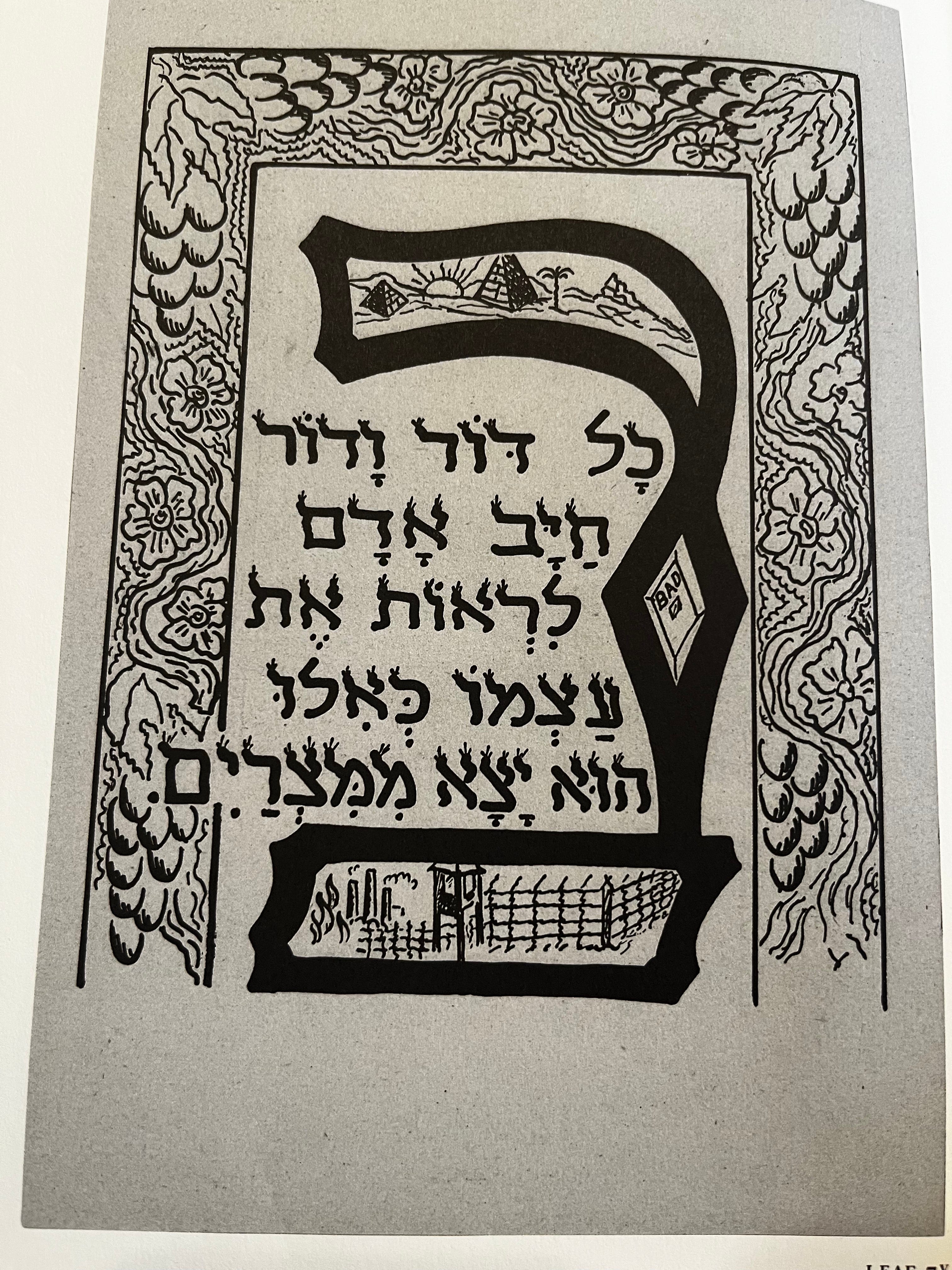
Saul Touster, whose English commentary and historical notes to this unique text illuminate not only the challenging physical logistics for how the Haggadot were made (paper, printers, ink and typeface often bartered for meats, milk, cheese, cigarettes and other items in great demand in post-war Germany) but the internal Jewish crisis of saving the unimaginably damaged Jewish bodies, souls and psyches of the several hundred thousand Jews (among more than 20 million refugees at war’s end) who could not return to their homes in Eastern Europe because of a virulently persistent and violent antisemitism. And in the DP camps themselves, these Jews were often persecuted by the very Latvians, Lithuanians and Poles who tormented them throughout the war. It took President Eisenhower’s firing of General George Patton, whose diary betrayed his own hatred of Jews (whom he wrote about as “sub-human) to turn the tide toward real rescue.
And as Trouster points out, it was the newly appointed General Lucian Truscott who was then able to set up separate camps for Jews to protect them from their persecutors and initiate the vast process of a new Exodus of Jews to either British Mandate Palestine (where the Zionist movement was well underway in creating a Jewish state), or America, along with a number of other nations that would actually accept Jews.
Just as every year at Passover we ask, “Why is this night different from all other nights?” one might look into the pages of the Survivors’ Haggadah and ask, “Why is this Haggadah different from all other Haggadot?”
Imagine for a moment going deep inside the process of Israelite leaders leaving Egypt more than three thousand years ago and seeing the minutes and the countless documents that reflect internal debates about which direction to escape to; who to trust; what to eat; and what the whole experience of 400 years of slavery followed by a miraculous and previously unimaginable redemption; and you have an idea of what it’s like to study the Survivors’ Haggadah.
The creators of this Haggadah were all survivors. They emerged from the torture and near-death of the forests and ghettos and camps with a singularity of purpose: to leave Europe and go to the only true home the Jewish people had ever known: the Land of Israel. This first Passover in the American Zone in Germany in 1946 was, to paraphrase Theodore Herzl, “no dream.” It was a national liberation, a redemption from slavery, and it pointed in one direction, away from permanent exile and home, to the Land of Israel. “There is no such thing as a ‘bad’ or ‘good’ exile. Every exile leads to extinction. With the blood of our hearts, by the light of our faith, and with a final hope, we shall break through every wall. We shall break through and go up to the Land of Israel.”
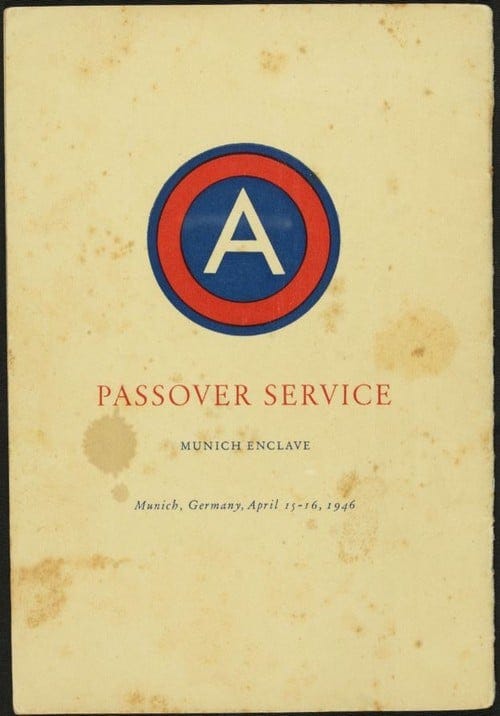
Under the protection of the United States Third Army, Jewish organizations like HIAS, the JDC, ORT, and countless others moved hundreds of thousands of Jews to Israel; and then to America, South America, Australia, South Africa — wherever Jews would be received.
The two main Jewish groups within the DP camps that drove this process were She’arit Hapletah (“the Surviving Remnant”) and Brichah. She’arit Hapletah saw itself, as its name suggests, as the “last of the Jews of Europe” who were given an almost Divine task to save the Jewish people. Brichah was the underground operation that sought to save Jews at all costs and shepherd them safely to Palestine, despite a British blockade, lifted only after the British withdrawal and declaration of Israeli statehood in 1948. Their Haggadah is an exemplary model for forging unity, singularity of purpose and radical focus on sublimating divisions for a greater purpose. With everything on the line for the survival of the Jewish people, they indeed saw themselves as if they had just come out of Egypt, but they we were still not yet out:
“And the number of Israel diminishes slowly. The children of Israel groaned and cried out but they were not heard. And they cried to the Lord, the God of their fathers, who saw their suffering and oppression, and their cry went up. And that man of evil, Hitler, made instruments of destruction which he sent across the sea, killing many. Babies were being killed and still no one knew what to do about it. Finally, the enemies of that man of evil grew indignant, and they girded themselves and unleashed against that man of evil and his people great wrath, rage, fury…
When peace came down to earth, the people of Israel were gathering. The surviving remnants were coming out of caves, out of forests, and out of death camps, returning to the lands of their exile. The people of those lands greeted them and said, ‘We thought you were no longer alive, and here you are, so many of you (fifty thousand out of three million!) And they sent the survivors all sorts of messages, telling them to leave the land, even killing them. And the people of Israel ran for their lives; they were sneaking across borders only to be robbed of everything they had. And they abandoned their monies, and they saved their lives, and they went to Bavaria in order to go up to our Holy Land.”
Studying this Haggadah in the context of contemporary Israel’s ruptured society is an object lesson in recognizing the enormous strength and courage it took to forge a unified set of goals for saving the Jewish people then, while blushing with shame at the almost Pharaoh-like grasp at power that Bibi and his government seek.
The Survivors’ Haggadah: “For thousands of years the Jewish People have commemorated the day of their Exodus from bondage. Through slavery, force, inquisition, destruction and troubles, the Jewish People have borne in the hearts a longing for freedom and expressed this longing universally so as not to leave out a single tormented soul.”
So as not to leave out a single tormented soul.
And then this: “From parents to children, from generation to generation, the story of the Exodus from Egypt is passed on as a personal memory; it never pales or loses its luster. ‘In each and every generation one should regard oneself as though he had come out of Egypt.’ There is no more complete fusing of the individual and the community to be found on the face of the earth and in the depths of the generations than this.” The fusing of the individual with the community is a rare idea for us to consider in this age of technology, awash as we are in the proliferation of the divine i — our phones — our personal platforms, the tik-tok tik-tok of our face-facing selves.
If there is generation in the last one hundred years who knew that fusing of self and community in their own bones, crushed and burned as they were under the weight of the Holocaust, it is the generation of those who bequeathed not only to us but all future generations this (and I don’t use this overused word often) transformational testimony to freedom.
While finishing up my study of the Survivors’ Haggadah yesterday, news flashed over the transom of a defiant speech just delivered by Israeli Prime Minister Bibi Netanyahu. In addition to doubling down on his proposed judicial reforms to aggregate power into his coalition government and away from the courts, the Prime Minister also celebrated the passage of a law that would further protect him from corruption indictments pending in the very courts he is seeking to eviscerate. He is choosing his own power over that of the people. He is elevating the self over the community. He would save his own hide rather than keep the State’s founding democratic principles.
He and his friend Donald Trump, another lone tyrant trying his mightiest to outrun the democratic judicial process’ cogs and wheels, have lost the thread of what true leadership — selfless, sacrificial — is about. What happened to “all Israel is responsible for one another?” Where does the Talmud say, “Hold on to power at all costs?”
“What a thirst for freedom lies in the heart of a People who could, in its springtime, bring forth such an ingenious creation and transmit it from generation to generation,” wrote Berl Katznelson, a Zionist leader whose text was included by the editors of the Survivors’ Haggadah.
That these selfless and heroic victims of the genocidal mania that gripped the European continent during the Second World War could not only imagine but reify the Spring — that would have been enough.
That these survivors of the Shoah, who had every right to claim victimhood and walk away from the God who could not save them wrote a Haggadah extolling the Divine promise to future generations — that would have been enough.
That you and I have the privilege of sitting at our Seder tables with the full recognition that we are doing so because of sacrifices made on the altar of Freedom, Justice, Love and Peace, for all who walk this Earth. That must be enough. That has to be enough. That will be Enough to keep on fighting until we get to the Promised Land.
Dayenu.
Next Thursday March 30 at 7 pm I will be teaching about the Seder for the Jewish Community Alliance of Southern Maine. You can sign up here!