
Remember Our Duty
And Perform It Without Complaint

A nine year old African child, bundled to protect herself from the cold, is walked by a neighbor to a bus stop here in Portland, ME, where I.C.E. activity has rounded up and arrested more than 200 people, including many parents with children who have fled war-torn regions across the globe. According to today’s Portland Press Herald, most of those arrested are unaccounted for and the federal authorities refuse to work with families and legal representatives in ascertaining their whereabouts. For the crime of being immigrants — many of those arrested are here in the United States legally though not citizens — these individuals have been, for all intents and purposes, disappeared. It is a grotesque stain on the idea of the American democratic project.
Being bundled against the cold is not the only protection for this nine year old child. There is, thank God, the shelter of neighborliness, undergirded by the cherished biblical values of “love your neighbor as yourself” and “love the stranger.” My neighborhood in Portland has come alive in ways that perhaps people were always waiting for, as one parent remarked to me this morning — with generosity, courage and love. The frigid weather here in Maine, compounded by the cruel and ruthless idiot winds of hate for the other as exemplified by the Trump administration, are daily blasted by the fiery heat and love-generating warmth of neighbors and strangers — holding children’s hands from homes to bus stops to schools and back home again, to a tenuous safety, where parents hide behind shaded windows, in dark houses, waiting for this cruelest of American winters to pass.
The nine year old asks her guardian volunteer, “Do you believe in God?” The guardian volunteer smiles at the purity and the innocence of the question and answers “yes” while then asking the refugee child if she too believes. “Yes!” she bellows, “God brought us here!”
The God of Unity and the Oneness of Humanity. The God of Love for Neighbors and Strangers. That God brought her here. Even in the face of this peculiarly odious American cruelty, it’s still better here than it was there.
I dare you not to be moved.
Of course, this is the story of one child. Now multiply that by a factor of thousands and then to multiples of thousands more; and expand the map beyond Maine to locations across the country where I.C.E. is operating or threatening to soon operate. In the face of this unaccountable stripping away of any semblance of legal status, stateless immigrants are now living with little to no judicial recourse (except in rare cases where intrepid and principled judges have stepped up) in fear of authorities.
Historical analogies abound. Traumatized memories resurface. It’s human.
I do not count myself among those who had a problem when Minnesota Governor Tim Walz (who has a masters degree in Holocaust education) said of I.C.E., “We have got children in Minnesota hiding in their houses, afraid to go outside. Many of us grew up reading that story of Anne Frank. Somebody is going to write that children’s story about Minnesota.”
Donald Trump’s U.S. Envoy to Monitor and Combat Antisemitism, Rabbi Yehuda Kaploun, said the governor was “cheapening the horror of the Holocaust.” In his hollow objection, he got the basic facts wrong about who exactly the Franks actually were. And as Professor Joel Swanson so concisely argued recently, citing the philosopher Hannah Arendt’s Origins of Totalitarianism, “the destruction of rights doesn’t begin with camps or mass murder, but with the revocation of political belonging. Citizenship, she insisted, isn’t merely one right among others; it is the condition that makes rights intelligible and enforceable at all. Once individuals are expelled from the political community, they lose what she famously called “the right to have rights.”
Walz didn’t say that I.C.E. was committing a Holocaust. He didn’t say Trump was Hitler. The governor made an appropriate historical reference to the dangers of and risks involved when human beings are stripped of legal protections, forced into hiding, and live in fear of deportation. He applied one of the most important lessons of the Holocaust that, as Swanson wrote, again referencing Hannah Arendt, “the danger of treating the Holocaust as absolute evil lies in how it severs genocide from the political, legal, and administrative processes that actually produced it. When atrocity is mystified, it’s no longer understood as the outcome of decisions made by identifiable actors operating within institutions, bureaucracies, and states. Evil becomes abstract rather than organized; moral rather than political.”
One can and must believe in both the uniqueness of the Holocaust and in the radical dangers of authoritarianism and totalitarianism in any context now and into the future when legal rights and due process are stripped away from our neighbors. To prevent future genocides, one must understand the legal circumstances and underpinnings that can lead to mass imprisonment and mass murder. Analogies are not mirror images. They are rational tools, applied critically, so that we might understand our present.
In fact, the Franks in Holland were former German citizens stripped of their citizenship for the crime of being Jews and then, with the Nazi invasion of the Netherlands in 1940, were made doubly stateless under the administrative regime of Arthur Seyss-Inquart. Without “the right to have rights,” it’s a series of increasingly easier steps toward further deportation, violence and death. This is history, the Holocaust’s, terrible warning.
It was a moving and powerful experience to be in Amsterdam recently as this debate roared forth back home in the U.S. Over the course of three days there, Yael and I toured the De Nieuwe Kerk Amsterdam’s exhibit called “Mokum,” about 350 years of Jewish life in the Netherlands, a sensitively rendered collaboration with Jewish Cultural Quarter; welcomed Shabbat in prayer with the community at the Portuguese Synagogue where I sat under the memorial plaque for a relative of the famously excommunicated Baruch Spinoza; toured the Anne Frank House — a truly extraordinary museum experience, made even better by an incredibly well-prepared and passionate educator (thank you, Alnordys!); and then, most movingly, found the apartment building in Rivierenbuurt on Gaaspstraat where Yael’s mother was born in 1946 after her parents, stateless German Jews, came out of hiding in Holland at the war’s end to start a new life as free Jews in Amsterdam. Being a “free Jew” in 1946 is not a light matter. At the end of the block on Gaaspstraat there is a memorial to the annihilation of the Jews on the site of the “Jews market” where Jews were forced to sell, then rounded up before deportation. Stolpersteine are everywhere here, including in front of the Frank’s house in the neighborhood. Given that more than 107,000 of the Netherland’s nearly 140,000 were murdered by the Nazis, the tripping stones are a wrenching testimony and an ongoing warning.
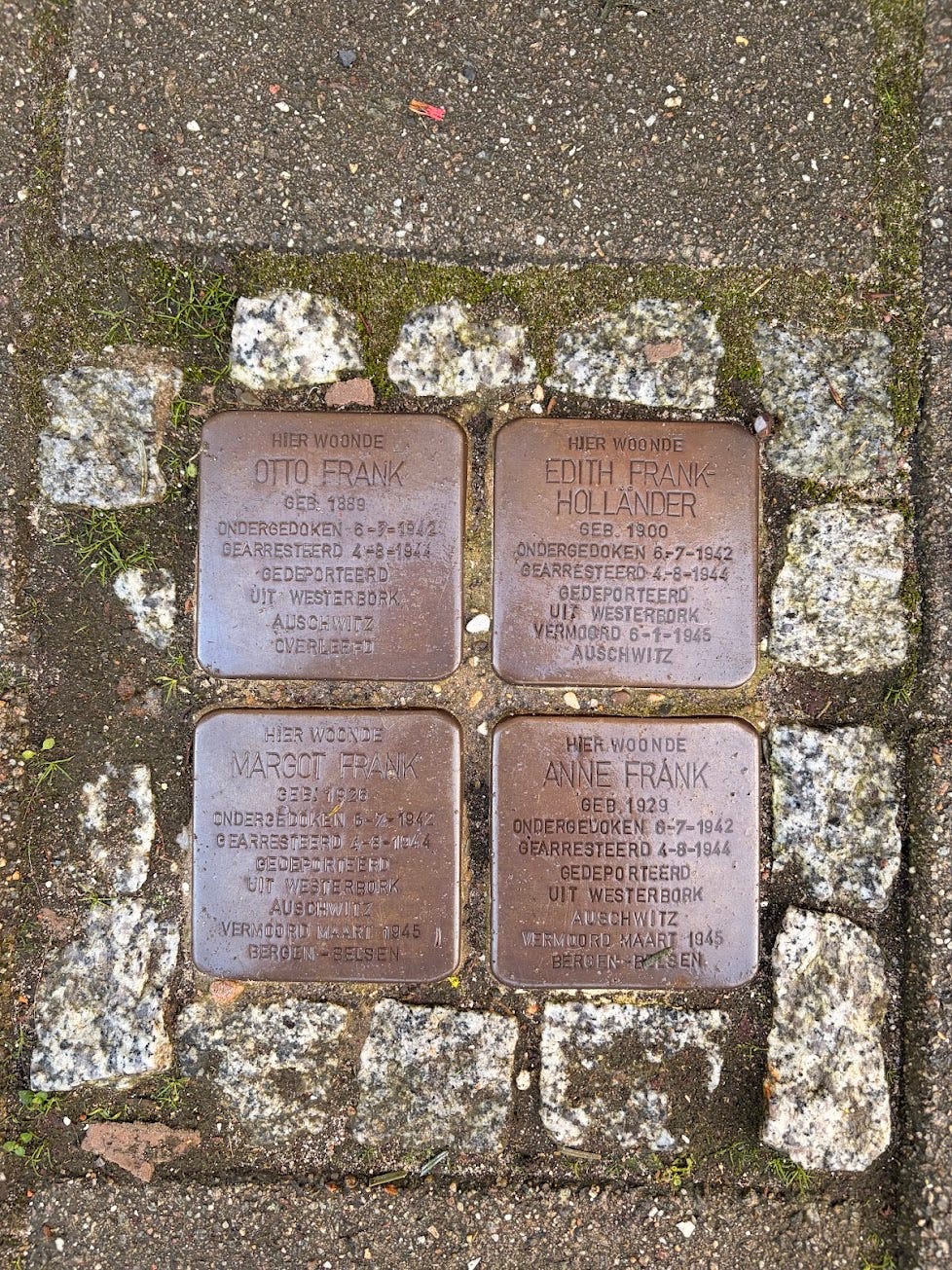
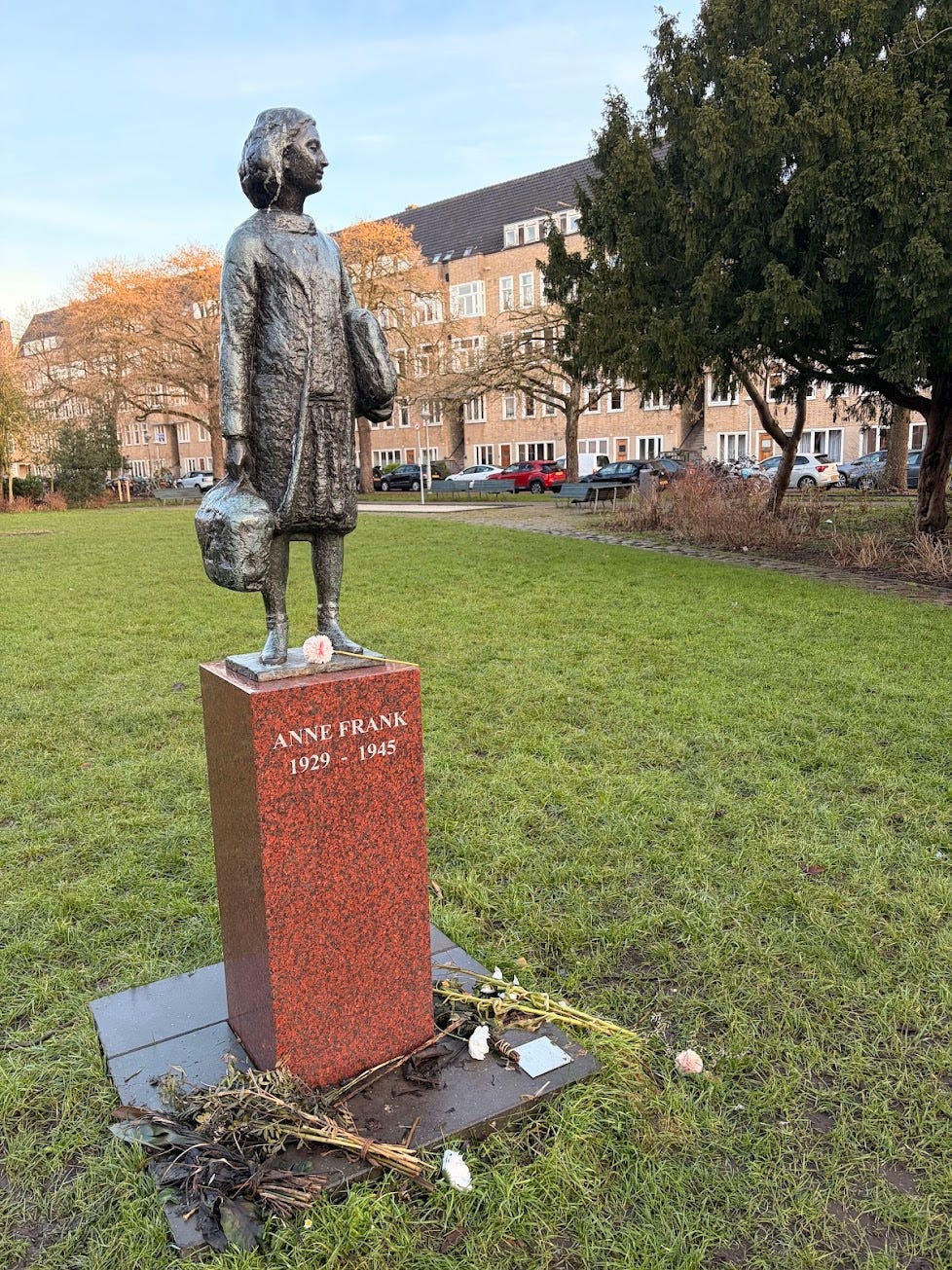
Here is Yael in front of her mother’s birthplace.
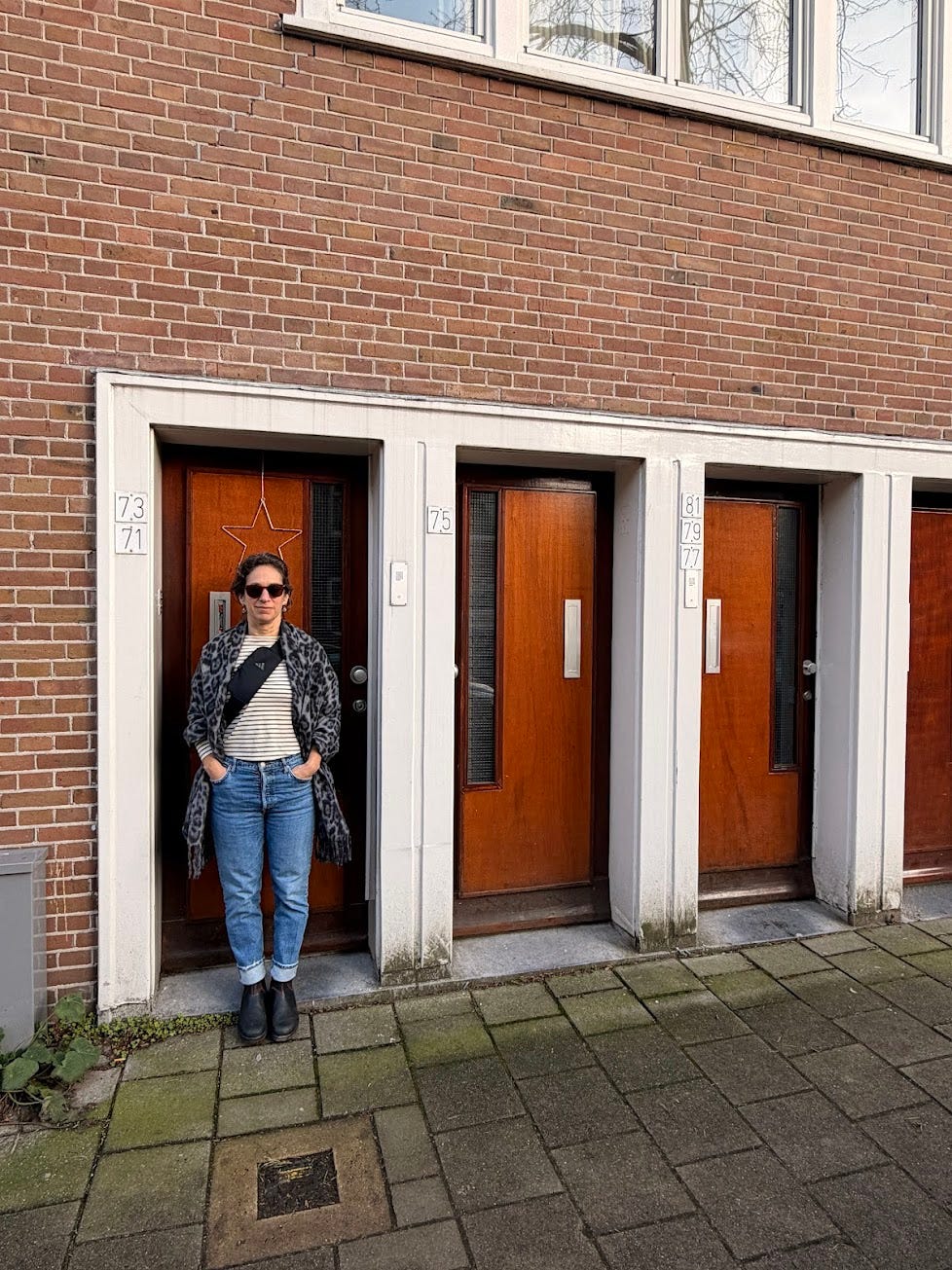
And here in front of the Frank’s last residence before they went into hiding.
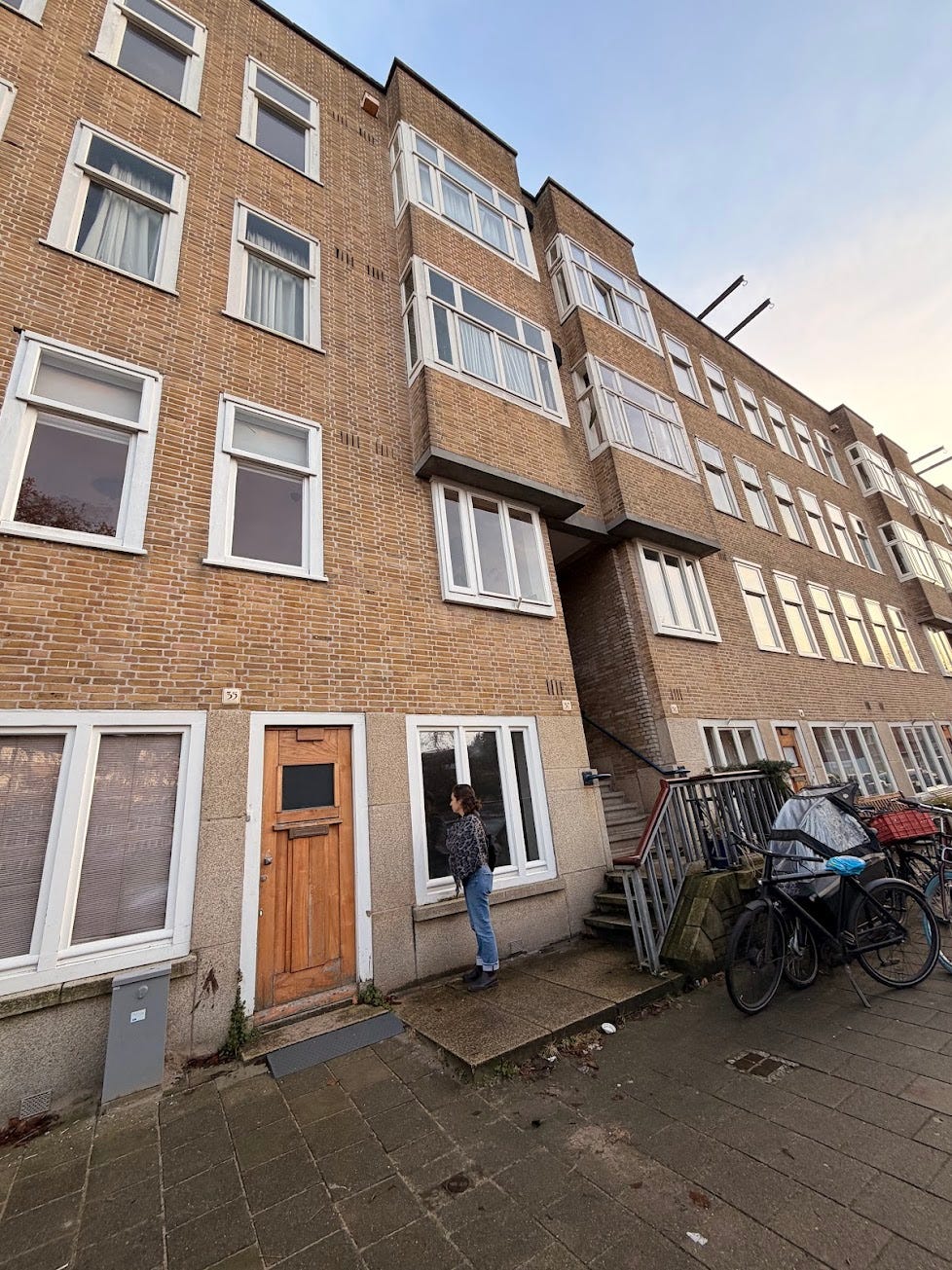
While leaning down to take a picture of the Frank tripping stones, the tenant of the Frank’s former address returned home with her dog, who proceeded to jump on me, lick my ear, and demand attention. I asked the tenant what it was like to live in Anne Frank’s last address and have thousands of people stand in front of her apartment each year. “I rather like it,” she said. “It’s a reminder of what happened and a chance to talk to people about what history means to us now.”
Very neighborly, don’t you think?
In Amsterdam I also got to see my dear old friend and painter Daniel Bodner, who has a show up, “Memory,” at the Roger Katwijk Gallery. There’s truly nothing like old friends.
On our last day in the city we visited the Rijksmuseum. While watching a team of restorationists work on Rembrandt’s “Night Watch,” we struck up a conversation with Anita Liemberg, an art historian and professional tour guide who was wearing a button that said, “Ask me anything” and so we got to talking about Rembrandt, his subjects, and, among his many characteristics, his subtle uses of mourning, pique, humor, even play, to animate his work. To illustrate a point, we walked over to a different section of the gallery to view up close “Isaac and Rebecca, or, the Jewish Bride,” a painting of incredible feeling, warmth and love. Amongst art historians and Rembrandt experts, it’s a matter of contention over just who Rembrandt was meant to portray here and I blurted out that it must be Isaac and Rebecca since the placement of the man’s hand on the woman’s breast is a direct expression of the Biblical text in Genesis 26, when Isaac pretends to the Philistine king Abimelech that Rebecca is his sister but is then seen by the king playing flirting with his wife behind closed doors. I quoted the Hebrew, a well-known Biblical pun based on the double meaning of Isaac’s name, Yitzhak, connoting Sarah’s laughter upon hearing that she and Abraham would have a son in old age (v’titzkah Sarah) and the fact that Isaac’s older brother Ishmael teased or played roughly with or perhaps even introduced idol worship (metzahek) to his younger brother.
The text from Genesis 26:7-8 reads:
וַיְהִ֗י כִּ֣י אָֽרְכוּ־ל֥וֹ שָׁם֙ הַיָּמִ֔ים וַיַּשְׁקֵ֗ף אֲבִימֶ֙לֶךְ֙ מֶ֣לֶךְ פְּלִשְׁתִּ֔ים בְּעַ֖ד הַֽחַלּ֑וֹן וַיַּ֗רְא וְהִנֵּ֤ה יִצְחָק֙ מְצַחֵ֔ק אֵ֖ת רִבְקָ֥ה אִשְׁתּֽוֹ׃
When some time had passed, Abimelech king of the Philistines, looking out of the window, saw Isaac fondling his wife Rebekah.
“Yes, yes,” the art historian said. “I know the Hebrew. I’m Jewish too.” And then when we told her about our previous day and the visit to Yael’s mother’s birthplace, she said, “My mother was also born in 1946 after my grandparents came out of hiding when the war ended.” Ah, Jews.
Fitting for the namesake whose image we were parsing, we laughed.
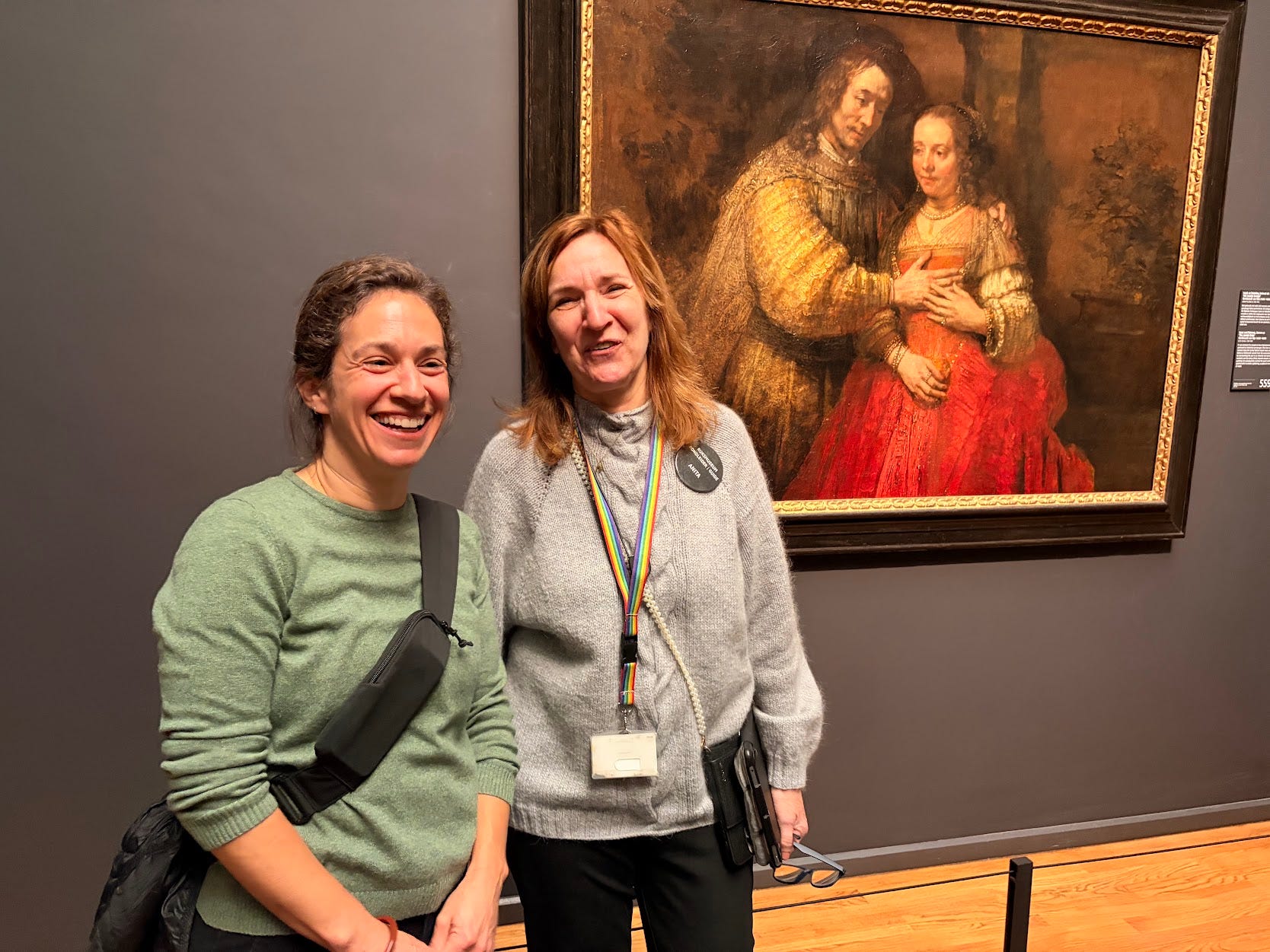
But then we leaned deeper into the conversation. Anita made the case that Isaac’s face resembled that of Rembrandt’s son Titus and Rebecca’s face resembled Rembrandt’s second love, Hendrikje — both of whom had recently died. The painting, through this interpretive lens, was not about play but was rather about consolation, about comforting the mourner, and ultimately about love.
As I sit here thinking and writing, I am reminded of the Biblical scene where Isaac and Rebecca meet for the first time. After the sacrifice of Isaac by Abraham, Sarah dies. Isaac and Abraham never speak again, though Abraham does hire his servant Eliezer to go find a wife for his son and that’s when Rebecca enters the picture. She comes from Haran, the place which Abraham and Sarah originally migrated from when God sent Abraham on his mission to be a blessing in the land of Israel, then called Canaan.
When Isaac and Rebecca meet, the Torah says Isaac is alone in a field, meditating before evening (וַיֵּצֵ֥א יִצְחָ֛ק לָשׂ֥וּחַ בַּשָּׂדֶ֖ה לִפְנ֣וֹת עָ֑רֶב) Rashi says Isaac’s words were the “prayer of the afflicted. “ It’s not hard to imagine the trauma he experienced as he lay upon the altar, his father’s intended sacrifice to God. Seforno relates the Hebrew word for “meditation” ( לָשׂ֥וּחַ) with the word for “bushes” (הַשִּׂיחִֽם) where Hagar briefly left her child Ishmael in search of water after they had been expelled from Abraham and Sarah’s house over conflict among this complex, blended family.
This web of associations take me back to the painting of two beloveds in a posture of consolation. Whether they are lovers, neighbors, former-citizen refugees fleeing oppression, or a composite of Rembrandt’s own need for comfort in his mourning — each image knows the exigencies and the intricacies of what is required for shelter, for sanctuary, for safe haven, from trauma, statelessness and death. And there is no greater urgency than the consoling presence of one with another.
Two grandchildren of Holocaust survivors meeting in the Rijksmuseum in front of a Rembrandt work about consolation is more than coincidence. It’s a revelation of a truth we need to be reminded of each day. It’s a testimony to memory, trauma, presence, healing, and a commitment to continue weaving patterns of connection among us all. It’s a formula for redemption.
That is what I am seeing among my neighbors here in Portland. It’s a kind of consoling presence that people are practicing in countless places throughout our country — neighbor to neighbor — as a necessary and intrepid response where I.C.E. is unjustifiably terrorizing families and children in the name of some kind of justified legal immigration enforcement.
Love your neighbor. Console your neighbor. Love the stranger because you were a stranger and one day you may again be.
In April 1944, as days of Nazi occupation continued to darken prospects of survival for Anne Frank, she nevertheless remained ever hopeful. The brilliance of her writing remains a beacon for us and thank God she is remembered. I close with the following passage:
“Be brave! Let’s remember our duty and perform it without complaint. There will be a way out. God has never deserted our people. Through the ages Jews have had to suffer, but through the ages they’ve gone on living, and the centuries of suffering have only made them stronger. The weak shall fall and the strong shall survive and not be defeated!”
Hazak v’amatz, we say.
Be strong of good courage. God brought us here,
Shabbat Shalom
Another important and beautifully written piece. Thank you.
I am 100% with you on Tim Walz. When I began to read about the backlash to his statement I was moved to write to him to let him know how much I appreciated his analogy. It is further clarifying to read the reasons you so beautifully lay out and the articulate comment from Neural Foundry
Thank you both