
Joy and Determination
Now More Than Ever

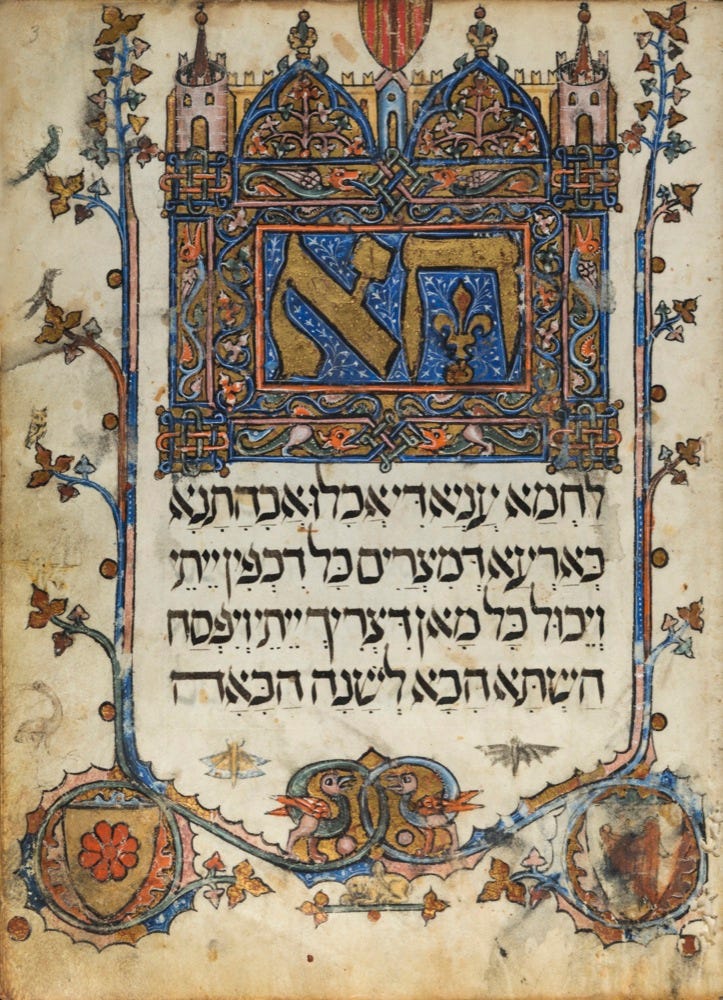
This is the bread of affliction our ancestors ate in the land of Egypt
Let all who are hungry come and eat
Let all who are in need come and join us for the Passover.
Now we are here; next year in the Land of Israel.
Now we are slaves; next year we shall be free.
===
On Wednesday evening at sundown, Passover Seder leaders around the world will hold up a piece of matzah and recite these words as we Jews proclaim, as a first act, that the centerpiece of our meal is the bread of the poor.
What follows are some thoughts to consider as you prepare for Passover.
Matzah: unleavened bread made in haste moments before our ancestors escaped slavery in Egypt after 400 years of oppression. Matzah: the quintessential symbol of our Redemption, commanded by God to the Jews in Egypt with the words, “This is how you shall eat it: your loins girded, your sandals on your feet, and your staff in your hand; and you shall eat it hurriedly: it is a passover offering to the Eternal.” (Exodus 12:11) Matzah: the bread of humility, of the enslaved suddenly, miraculously freed. And so it is: the bread that is baked with no time to rise, consumed on the go. It is the bread of the refugees. Avadim Hayinu. We were slaves, now we are free.
Therefore the Torah teaches and commands us to “love the stranger because you were strangers in Egypt.” How can we not, on this night, think of the thousands of our neighbors arrested, jailed, deported or killed in custody for the crime of their existence as strangers in a strange land? “How is this night different from all other nights,” indeed.
And for those Jews who maintain the deep connection between their Judaism and their Zionism, there are scoffers among us, now more than ever, and so this night is different as well. There are those who make a mockery of Jewish suffering, of the Jewish story, of the Jewish claim to the land of Israel, especially those who reject Zionism in principle; who reject the Jewish national claim to a homeland; who are among the monomaniacal mass that would undo the Jewish state with boycotts, divestment, sanctions, or terror from tunnels and the skies, “by any means necessary,” as their delegitimizing campaign would have it, often under the flag of Hamas and Hezbollah, at rallies even here in America.
There are legitimate criticisms of Zionism as it is currently being represented by the ruling coalition in Israel’s parliamentary government, to be sure. There is the Zionism of millenarianism — “the end of days” — a dangerous and illegitimate marriage between Evangelical Christians and the Israeli settler movement that seeks to cleanse the land of Palestinians, using the Jews as the tool to ultimately bring about the Second Coming of Christ. There is the vengeful Zionism of those who would pass a death penalty law in contradiction to Israeli jurisprudence not only since that state’s founding but in contradistinction of the entirety of Talmudic law; there are the threatened jail sentences for non-orthodox prayer at holy sites in Jerusalem; there is the making of common cause with authoritarian, anti-democratic figures across Europe in the name of Judeo-Christian supremacy; and there is the dehumanizing Zionism of vengeance, which confuses the human desire for revenge with the fundamental Jewish belief that only God has the power to enact vengeance for acts of pure evil. (Deuteronomy 32:35)
None of these statements prevent me from remaining a proud and committed Zionist, just as I remain a proud American, despite the corrupt, delusional, destructive and vindictive policies of the second Trump administration.
Citizenship of any kind is, after all, a representation of reality as well as an aspirational ideal. We ought to always be striving, in the best of all possible worlds, for a better version of ourselves, as individuals and as a collective. Israel’s failures; America’s failures – any nation’s failures – ought not to cancel out the project of self-determination entirely.
As an American it’s why each July 4th I read the Declaration of Independence and Frederick Douglass’s brilliant response, “What to the Slave is the Fourth of July?” Critical thinking is one of the greatest tools for liberation and freedom.
It’s a strange and I dare say particularly obsessive compulsive disorder of many in this micro-specific demand-saturated generation to require of governments an imagined purity of purpose and execution in policy, which, for anyone who has ever studied a shred of history knows, is messy, complicated, plodding and imperfect. As my dad used to say to a younger, more impatient version of myself, “Life is two steps forward and one step back.”
This Passover feels unprecedented for Jews around the world. October 7, 2023 undoubtedly unleashed a wave of global antisemitism consistently worse than at any time since the Second World War. Violent and deadly attacks upon Jews for the crime of being Jewish – often under the guise of anger at or in response to Israeli policies and actions against Palestinians – are at an all time high. There is no doubt that the Hamas attacks of October 7 and the campaign from Hezbollah and Iran to attack Israel on an additional two fronts, has brought unprecedented death and destruction to tens of thousands of innocent Palestinians, Israelis, Lebanese and Iranians. This war is an unmitigated hell; it’s the longest war to date in Israel’s history; and from the perspective of most Israelis and most Zionists, it is a war for the very existence of Israel as a Jewish state; or, from the perspective of Hamas, Hezbollah, Iran and their anti-Zionist allies, it is a war to eradicate the Jewish state. Until such a time when the most dangerous extremists are marginalized, this death spasm will hold us all in its grip.
And so when we ask “why is this night different from all other nights,” we are, in part, wrestling anew with the insidious claim that Zionism, the Jewish claim to self-determination, is, at best, not worthy of serious consideration and at worst, pure evil. The idea of Jewish homeland, in this view, is not grounded in historical reality but is, rather, a colonialist project and therefore worthy of utter and total rejection. Which explains Palestinian rejectionism of Zionism since its inception; explains generations of terrorism against Israeli civilians in Israel and Jewish civilians abroad since the Balfour Declaration; and is the final word of justification for October 7, 2023. Full stop. With two totalizing world views locked in as they are, there is no room for compromise, which really, is what we need.
“This year we are slaves, once again, to a conflict that seems to have no end.”
But because I am a Zionist, I believe not only in self-defense, in the pride of the creation of the first Jewish state in nearly two thousand years, in the fullest expression of Israel as a creative, vibrant, free, innovative, joyful society, I am also as a Zionist bound to be fiercely self-critical in my thinking – and I dare any self-respecting Palestinian or bleeding heart Palestinian activist to have the courage, honesty and self-awareness to testify accordingly – Jewish hands are not clean either. Israeli policies of ethnic cleansing; documented massacres in wartime; expansionist policies in territories captured in wartime; racist policies with regard to education, housing, health care, civil rights, sanitation for godsakes – all incontrovertible evidence of Zionism’s failure to uphold the ideals of Israel’s 1948 Declaration of Independence – these policies are to be fought against, eradicated, and replaced by the newly formed pillars of a “more perfect union” in a complex, ever-evolving reality.
Turn back the clock, if you will, to the late 20th century, when Palestinian extremists insisted on blowing up themselves and innocent Israelis for the idea of coexistence; and Jewish extremists brutalized Palestinians and then assassinated Prime Minister Yitzkah Rabin, the compromising peace-maker, and ask yourself: “What if those who would have compromised for the sake of peace prevailed?” Where would we be now?
A race to the bottom has gotten us to where we are. And the bottom, as our Sages have taught us, is the place of utter and total degradation but also the source of inspiration to rise up and transcend.
From Degradation to Freedom: This is the Seder’s journey from Slavery to Redemption. The slave mentality holds us down with broken spirit; faith and hope lead us through the parted waters of the Sea of Reeds to Liberation. That’s the point of the Passover story each year. To acknowledge the low places and despite its pain, sorrow and suffering, to dare to transcend it once again.
As a ritual, the Passover Seder is a religious narrative drama. Its script – the Haggadah – is meant to take the readers and participants (the actors and the audience) on this journey from the degradation of slavery to the praiseworthy reality of freedom.
To give you a sense of this remarkable literary and religio-national and historical celebration, imagine, if you will, in the African American context, a set holiday and meal each year that recounted capture, Middle Passage, centuries of slavery, the Civil War and Emancipation Proclamation, Jim Crow, and finally, the passage of the Civil Rights Act of 1964 and the Voting Rights Act of 1965. Imagine stories, historical accounts, songs, foods, argument and debate about whether or not true freedom has yet been realized. And then imagine that ritual being practiced, in all of its complexity, for more than two thousand years. That’s Passover.
We remember. We sing. We debate. We eat. We give thanks. And we begin again, renewed in our commitment to build a better world.
This year as we begin our Passover, it seems the world is on fire. War in the Middle East is reverberating in virtually every economy across the globe. Extremists of every religious background see a great civilizational battle taking place while, as always in times of war, the innocent hide and shelter as bombs fall. The temptation to yearn for finality is great. Who among us is not exhausted from war these last few years?
But as we examine these above words, a kind of distillation of Passover’s message, let me suggest that we see not a vision for the grand, messianic sweep of history but rather the small, aspirational yearning for generosity – “let all who are hungry come and eat” – as well as declaration of faith that while redemption is not yet here, it will come, “next year in Jerusalem,” as we recite with faith and hope at our Seders’ end.
There is a Jewish teaching in the Talmud that says if a person is planting a tree by the roadside and someone comes to tell you the messiah has arrived, first, finish planting the tree. Then go greet the messiah.
This is Judaism at its most practical. This is a system of belief that teaches one should maintain faith and hope but also be rooted, with our actions, with the mitzvot, in the dogged realism of the here and now. And so perhaps in this context one might consider the Four Questions core operational proposition: “Why is this night different from all other nights?”
Around our Seder tables, on the Night of Questions, we should not only review the foods of the Seder table as being different from all other nights of the year but of course, discuss the meaning behind the salt water and parsley; the matzah; the bitter maror; the sweet mortar of the haroset; the shank bone of the Pesach sacrifice. We should also open our hearts and minds to sharing how this night, this year, is different in other ways as well. How have we grown in learning and action and how can we continue to grow? Who have we lost in the last year and how can we remember them with stories, memories, good deeds and acts of lovingkindness? Are we looking beyond our own families, our own circles, and remembering to “love thy neighbor as thyself?”
There is so much work to be done to make the world a better place, so many trees to plant, as it were.
Rabbi Kalonymus Kalman Shapira, writing from the darkest midst of the Warsaw Ghetto, taught that on Passover, a person should still sing, still express joy and gratitude for the inherent sacredness and privilege of life itself. And that in offering up the prayers for hope and redemption, “next year in Jerusalem,” that our sacrifices going up will meet God’s holy fire of love and protection, coming down from above.
May our words and songs; our prayers and conversations; our remembrances and our reified commitment to doing good in this world, bring about soon a time of justice and peace for our people and for all of humanity.
Hag Sameach and a Zisen Pesach.
May you find joy, sweetness and determination to do what is loving, just and right in this Passover season.
Andy - I’m honored to be a friend and teaching colleague.
The description of your ‘Zionism’ matches mine to the letter. Thank You for being specific and clear.
shalom / salaam and sweet Pesach to all.
Andy, thank you so much for giving me a place not to feel alone at this very confusing time. Did you mean Zionists in this sentence? "and from the perspective of most Israelis and most anti-Zionists,"