
In Other Times
There Stands Another Who Stares Into Space

Being stuck on a delayed train outside of Munich is as good a place as any to start this first reflection on my recent ten days in Germany, visiting Munich, Ellwangen, Ulm, Landsberg, Augsburg, Gunzenhausen.
A Memory Trip. Like the yizkor books created by survivors of destroyed European Jewish communities, a trip such as this feels more necessary than ever for the fractured world in which we currently live. The destabilizing reality of fierce and virulently oppositional divisions among and within nations draws me to these places of memory, to be reminded of what once was, how these places were destroyed, how those who live there and those who visit must come to terms with those destructions, and how, step by step, the willing among us might move forward into life, reconciled even, to a better way.
These were points of arrival and departure, each with resonances that run deep, centuries old, a once effulgence of Jewish life now gone; an ancient hatred hovering, lurking, the traumatic echo of the Shoah. But another dimension, too, found in a past that cannot be unmade and therefore only the work of the present, an eye toward the future, to move forward, however reluctantly, impossibly, one “accepts” what happened. To accept what is unacceptable for the purposes of being able to live in the present and build a habitable, tolerant and bearable, even hopeful future.
Forward and Future, two words repeated in these opening paragraphs. Like I’m talking to myself in the ring’s corner: Get back out there. Face it. Fight to remember, remember to survive. Tolerate the pain. Accept the friendships. It’s a lot of what it is to be a Jew in Germany. It’s home/not-home.
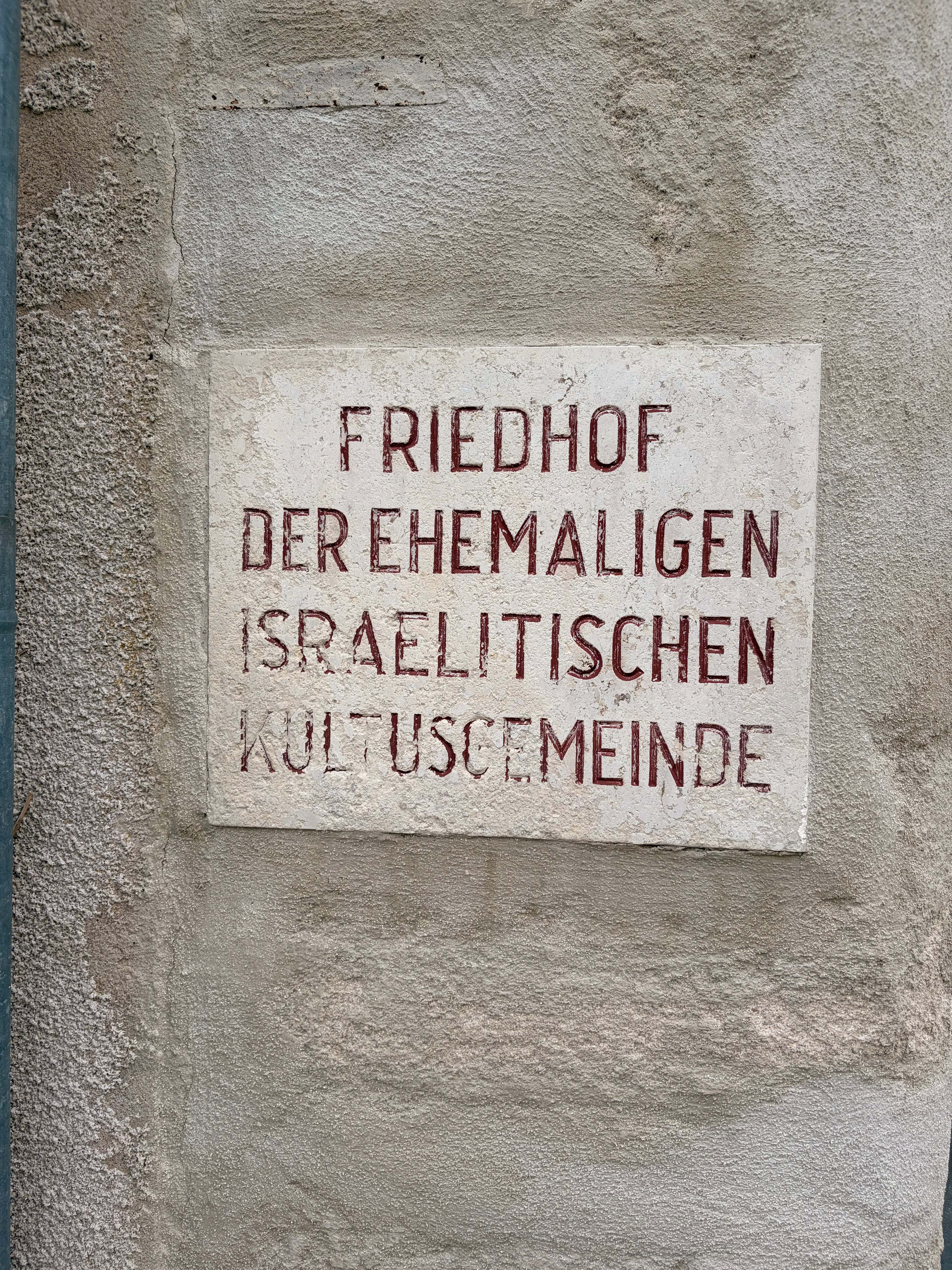
Maybe I’ll begin at the end: in the Jewish cemetery of Gunzenhausen, where we went to remember family members buried there in the early twentieth century before others had the chance to escape – or not, and face the fate of execution or fatal illness or starvation or miraculous survival in any number of the small concentration camps beyond Germany’s borders or so close to Munich that a short bus ride to the charming town of Dachau gives you enough of an idea that looking away from madness, destruction and extermination, “not knowing,” is its own impossible proposition.
And the haunting present intruding, too. Phone buzzing in my pocket with headlines from the day. I.C.E. kills another undocumented immigrant, mistaken identity, governmental obfuscation, accountability in shreds. Phone buzzing in my pocket with headlines from today. Antisemitism rising on the left and the right in American politics. War and extremism in too many directions. Political and societal fractures abound. Traumatic echoes reverberate. I try to stay rooted. I’m reading David Biale on Jewish power and powerlessness; Michael Brenner on Hitler’s Munich; Shulamit Volkov’s biography of Walter Rathenau, Weimar’s “fallen statesman.” History doesn’t repeat but its patterns evoke familiarity. Its stories reveal deep grooves of recognizable truths across seemingly disparate eras of time.
“Have a book with you at all times.” My mentor Lisa Goldberg told me that 25 years ago. I hastened to remind her I was a history student at the University of Wisconsin. A book in one’s bag at all times was the Badger calling card.
Back to the boneyard.
The Jewish community of Gunzenhausen dates back to the fourteenth century, when Ludwig the Bavarian in 1343 granted Jews their freedom. For the first hundred years of their existence there, trades were in money and cattle, two sufficiently “malodorous” professions to allow the Jews some semblance of subsistence, having been restricted from virtually every other profession or guild available throughout the Middle Ages. Expulsion mandates abound, throughout the last decades of the 16th and the first decades of the 17th century. This was not a particularly stable existence. Blood libels, expulsions, returns. Multiply this across Western, Eastern and Central Europe for more than 700 years. This is, in part, what the historian Salo Baron referred to as the “lachrymose conception of Jewish history.” Was it really only bad? Of course not. Jewish civilization roots itself and thrives wherever it resides — whether that residence is temporary or permanent. Nevertheless, the scholarship, the economic contributions in finance and industry, the foundational contributions to science, literature, music, historical studies, art – like Jewry throughout the world for more, German Jewry was a remarkable vault of social, economic, artistic and intellectual fertility. Who was more German than the Jew, afterall? According to the historian Abe Peck, the German assimilation of Jews following the Enlightenment was “unprecedented.”
A debate is always triggered when walking into the past, stepping over stones of darkness and light, rounding alleyways of contention into conflicting claims and accusations of a complex, kaleidoscopic past.
So, the cemetery in Gunzenhausen. In 1473 there was a Jewish cemetery in Gunzenhausen but that privilege was soon taken away and for 400 years, Jews in the area buried their dead elsewhere. In 1875, a new Jewish cemetery and synagogue were established in Gunzenhausen, where they would both stand until the Kristallnacht pogroms of 1938, when the synagogue was destroyed in vicious spasms of violence and fire and the cemetery was systematically dismantled, its stones spread far and wide, winding up as foundations of farmhouses, country walls, and other non-sacred uses. A couple dozen stones still stand, above plots estimated to be where the bodies of the memorialized lie. But more than 300 graves are unmarked and the stones have been lost to neglect or oblivion. I lost my breath at the enormity of the erasure.
We wandered the walled-in grounds like ghosts on behalf of ghosts. Or maybe we were like magnetic figurines above ground, moved by the attracted charge particles of witness bearing for those below. Our presence was like a silent, testimonial Kaddish dance to the memory underworld.
It was on toward seven in the evening and the summer sun was still radiant and hot. I felt sure that our real hosts, the unmarked dead, wanted us to remain. I covered my head with my yarmulke and thanked our living German hosts for bringing us there and tried to find words of meaning, reconciliation and truth. I recited in Hebrew the 23rd Psalm and then asked my new friend Matthias Knock, a Christian pastor, to recite it in German. Matthias started the Gunzenhausen interfaith dialogue group with Netanel Yechieli, great grandson of Karl Rothschild, the town physician, who lived in Gunzenhausen from 1919-1934 before his escape with his family.
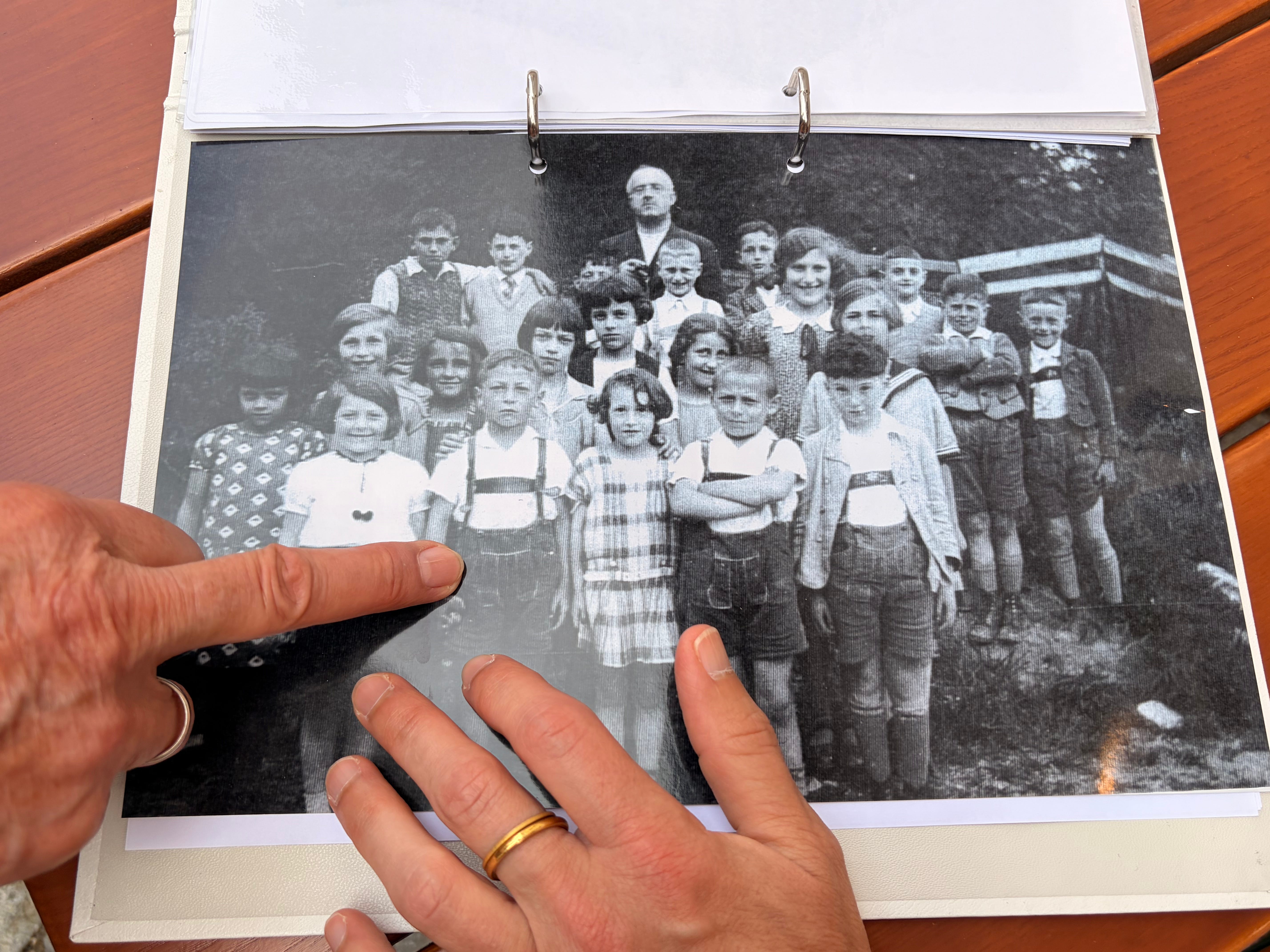
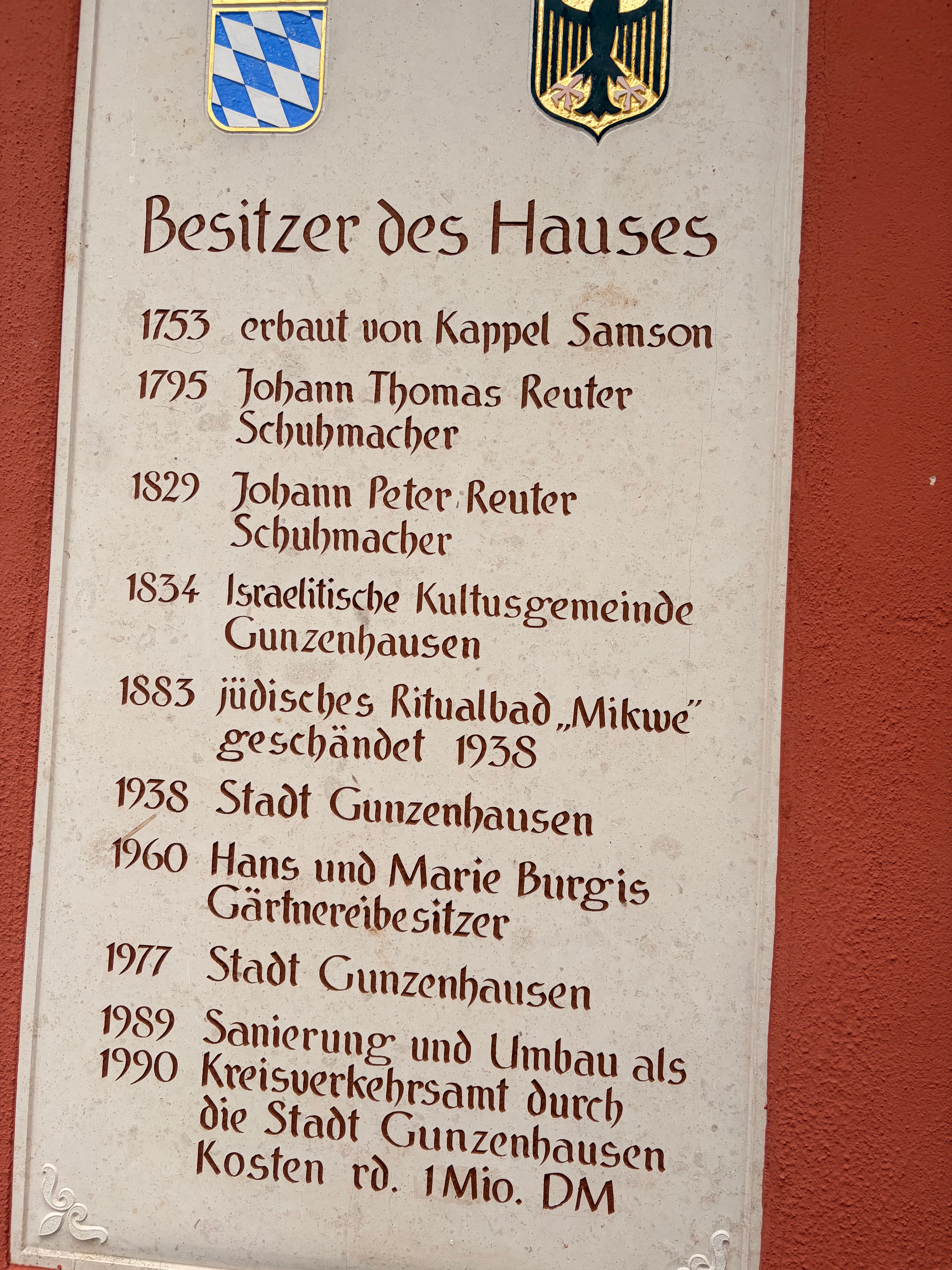
The local Germans who hosted us and Jews from abroad meet to talk and create shared projects of commemoration and history and this cemetery is one such site. In another part of town, a grove of red maples, each tree representing one of the last families of Gunzenhausen, bears witness; a local artist’s sculpture installation in the town center depicting real people from the town’s Jewish community calls you in; and wall plaques describing a building’s history, its Jewish inhabitants and their terrible fate explain, in plain language, what you are looking at.
Rashi, 11th century rabbinic scholar from Worms, about 230 km from Gunzenhausen, said of the first verse of Psalm 23, “In this desert where I am going, I am confident I will lack nothing.” This desert of memory; this desert of war; this desert of catastrophe; this desert of hands reaching out and not reaching out. Man’s inhumanity to man and man’s humanity to man.
יהוה רעי לא אחסר
Adonai Roi Lo Echsar
Der HERR ist mein Hirte; mir wird nichts mangeln.
The Lord is my shepherd; I shall not want.
I could not hold back my tears listening to the German, watching Matthias with eyes closed, holding his hands open, palms up and thinking of this most familiar of ancient religious metaphors. God is a shepherd guiding us. And here were in the Jewish cemetery of Gunzenhausen eighty-one years after the Shoah. What hubris to think we found our way there ourselves.
Yael and I were there because her mother Shula wrote a book about her father Max Rothschild, who was born in Gunzenhausen and as a young Zionist made plans to leave for Palestine to build the state of Israel. After an arrest and internment and torture in Buchenwald, he eventually escaped Germany for Holland where, after the Nazi invasion, he was hidden by a Dutch family until war’s end where he reunited with his partner Ilse. Shula was born in Amsterdam in 1946.
Shula’s guide some years ago in Gunzenhausen was and remains an extraordinary educator named Emmi Hetzner, who in 2000 at the Stephani-Middleschool who initiated a research project about the town’s Jews for her students. According to the website that Emmi eventually created, “The initiative for this came from Georg Weigel and Franz Müller, the rector of the school at that time. The know-how for the technical implementation of the research results in the present website jl-Gunzenhausen.de was provided by Horst Schäfer, at that time head of the municipal information and communication technology department.The research results were entered online by Franz Müller, who as rector always supported and promoted the activities of the project participants.
The research of the students was initially based essentially on the “Personal documentation of the Jewish residents of Gunzenhausen” and on the Housebook of the city. City archivist Werner Mühlhäußer made these important basics available to them, as well as his professional advice and personal involvement in the work of the young people.”
What hubris to think we found our way there ourselves.
Of course there is our will – I mean we had to take a plane, find a hotel, eat – but let’s be clear: there is an otherworldliness to going back to a home that no longer exists, to a town absent of its Jews, being guided by those who never knew Jews, until they themselves began to ask questions and the answers can be found in each of us standing there together.
Every war is in many ways everyone’s loss. We all bury and mourn our dead, except of course when we return, a generation or two or three later, to recite prayers over heaps of ash and mass graves. Sometimes victims of war do not even have the privilege of burying their dead. Yet still, every war is in many ways everyone’s loss.
Reflecting last night on this week’s Torah portion with the synagogue community I serve in Laconia, it occurred to me to note a strange parallel between the step by step journey, in the desert, that the Israelites took as they left Egypt, wandering for forty years until entering the land of Israel. When we set out on journeys – whether by choice or as a matter of escape – we never really know what might happen from one moment to the next, what we may see, who we may encounter and how it might change our fate forever. It’s written in Numbers 33:3-4 that as the Israelites began to leave Egypt the day after the first night of Passover, that the “Egyptians were burying those among them whom God had struck down.” It is a haunting image, a vibrating, silvery glow, a remnant-image of the dark night before the dawn, of the vanquished coming to terms with their own disastrous choices, judged and wrought.
Death the great equalizer. Memory, shared and divergent, the ground on which we meet.
Still is the night, the avenues rest
In that very house dwelt my sweetheart
She has long since left this town
But the house still stands on the very same spot
There stands another who stares into space
And rings his hands in deep pain
It chills me as I see his face
The moon reflects my very own form
You my double, you pale accomplice!
Why do you mock my love sickness
That has tormented me on this same spot
So many nights in other times?
–Heinrich Heine
In the coming days I plan to write a number of reflections on this profound journey. Of the “so many nights in other times” that we walked among for ten days in Germany.
I felt as though I was standing there with you, feeling the emotions you described…my people, our people……
while thinking of the people who are “different" living in our country….. now featured as news stories ….the people who don’t fit the mold.